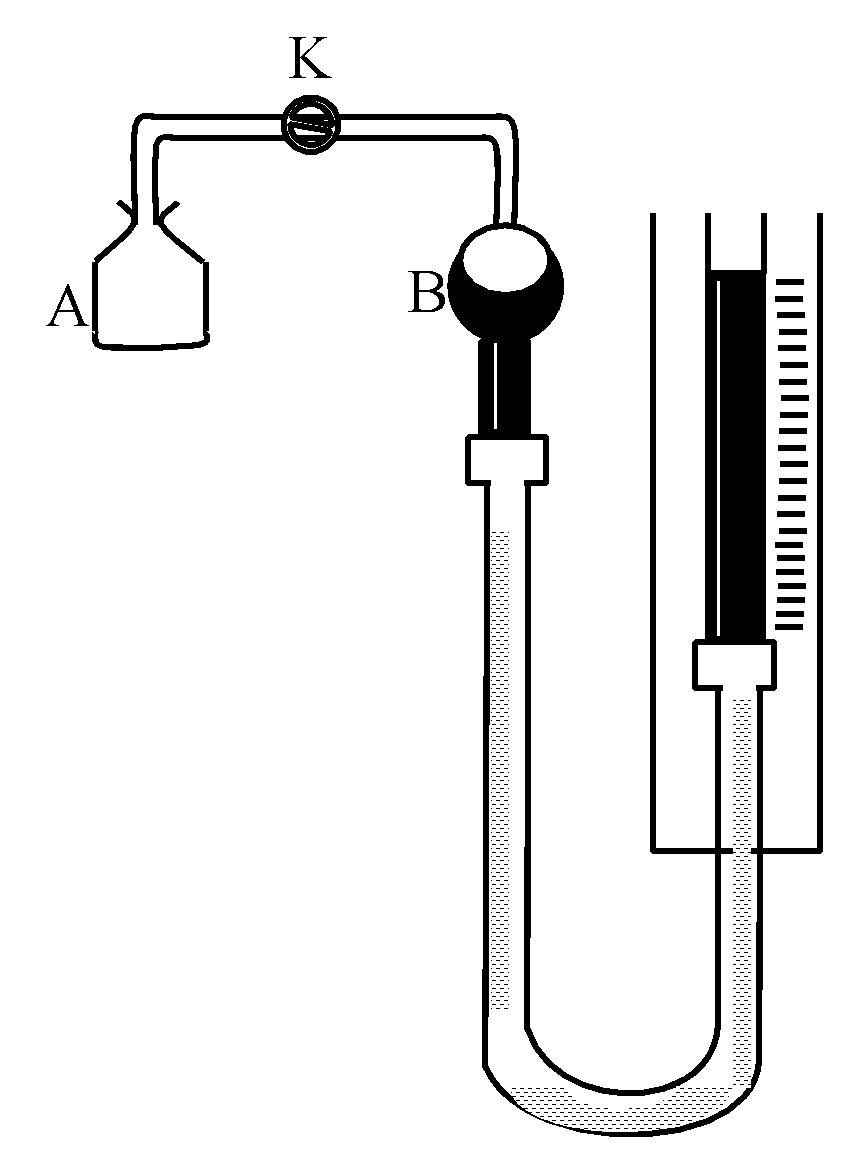
To measure the volume of a powder which does not react with air and does not absorb air, an apparatus is used which is called a volumometer. This apparatus is illustrated in Figure. A flask A is fitted, after grinding to give an exact fit, to a bent glass tube which has a tap at K and ends in a bulb B, which turns into a straight tube, This straight tube is connected by length of rubber tubing to another straight glass tube which can be moved vertically up and down a scale. Lines are marked at the upper and lower limits of the bulb, the volume between them being measured exactly and found to equal V. Both the straight glass tubes and the rubber tubing contain mercury, thus making a pressure gauge.
The volume of the powder is measured in the following way. Atmospheric pressure H is marked on the pressure-gauge. With tap K open the level of the mercury is brought to the upper mark on the bulb B and the tap is then closed.
Then the straight tube of the pressure-gauge is lowered down the scale until the level of the mercury in the bulb reaches the lower mark; the difference in the levels of the mercury in the straight tubes is then noted (h).
After this the apparatus is restored to its original position and the tap K is opened.
The flask A is then removed and the powder of which we wish to find the volume is poured into it. The flask is again connected to the tube and when the mercury in both tubes is on a level with the upper line on the bulb, the tap K is closed. The pressure-gauge's straight tube is lowered once more so that the level of mercury in the bulb B reaches the lower line and h', the new difference in levels in the straight tubes, is measured.
How can we find the volume of the powder, knowing the values of V, H, h and h'?
Text Solution
Verified by ExpertsCHECK THE SOLUTION.
Sol. Changes of pressure in the limbs of the pressure-gauge are related to changes in the volume of air inside the apparatus by Boyle's law.
So we have:
(1) Tab K open, no powder. The level of the mercury is brought to the upper mark on the bulb B. The air in flask A occupies a certain volume v. The pressure-gauge registers atmospheric pressure H.
(2) Tap K closed, no powder. The level of the mercury is brought to the lower mark on bulb B. The air occupies a volume V+v. Pressure is H–h.
(3) Tap K open again, powder has been poured into flask A; when the mercury level has been brought to the upper line on the bulb, i.e. at atmospheric pressure H, the tap K is closed. Evidently the air now in the flask and the connecting apparatus occupies a volume v', such that v –v=v 1 , the volume of the powder.
(4) Tap K closed. The mercury level is brought to the lower line on the bulb, as a result of which the volume of air becomes equal to v' + V, and the pressure changes to h'.
From Boyle's law we have:
from (1) and (2) vH = (v+V) (H-h),
v =  V
V
from (3) and (4) (v' + V) (H – h') = Hv',
v =  V.
V.
Hence the volume of the powder equals
v – v' =  V –
V –  V =
V =  .
.
Prepare Smarter with CGP Edu
Get practice questions, solutions, and test series in one place.
Write a Review
Share your experience with this question and solution.
Commentary
Send your comment, doubt, correction, or feedback to admin.
Similar Questions
Explore conceptually related problems